[ Home ] [ Railway Electrical Systems ] [ HEP ] [ HEP Generator Controls ] [ Generators for HEP ] [ HEP Wayside Power ] [ Railway Electrical Controls ]

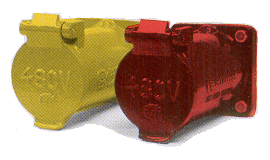
Typical HEP Configurations:
These are the various types of head-end power systems that Northwest Rail Electric has been involved with:
Amtrak Style HEP System:
Amtrak style HEP consists of twelve #4/0 wires running from one end of the car to the other. Power is 480 volts three phase, operating in 4 parallel sets. System capacity is approximately 1,200 kW. The end of each car is equipped with four HEP connectors: two fixed jumpers with cables, and two receptacles for the jumpers to connect to. There can be only one generator that feeds a set of cars. If two generators are used, then there must be some sort of electrical isolation between the two systems, such as one generator operating one set of cars, and the other operating another set of cars. It is possible for two or more generators to be in the same generator car and operate as parallel units in the same power plant. Each car has a HEP junction box where the 4 sets of wires join, in order to even out the electrical load between the cable sets.
We have a list of the parts required to convert a typical passenger car to Amtrak compatible HEP.
"Western Canadian" Style HEP:
In this HEP system, which has also been used in the USA on some operations, the basic connection and wire scheme are the same as in Amtrak style HEP. It consists of twelve #4/0 wires running from one end of the car to the other. Power is 480 volts three phase. However, the wires on the left and right side of the cars do not connect. They only tie together at the generator, if they do so there. The cars have an electrical system that allows selection between HEP A and HEP B. System capacity is approximately 1,200 kW. The end of each car is equipped with four HEP connectors - two fixed jumpers with cables, and two receptacles for those cables to plug into. Two generators can be used: one powering the A HEP system, and the other powering the B HEP system. In true Western Canadian HEP, at one end of the cars HEP A and HEP B cross sides, to allow for better load balance. Some adaptations of this system do not have the HEP system cross over, but true Western Canadian style does. There are two HEP junction boxes on each car. VIA style HEP adds an extra rotation to the wiring to help phase balance trains of cars that have duplicate loads, plus some other subtle improvements.
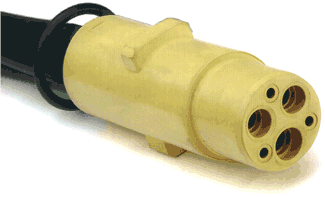
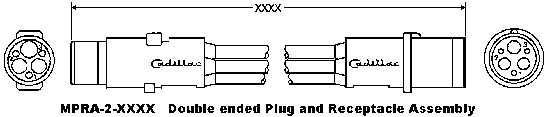
Each Head-End Power Connector is rated at 400 amps, 600 volts, with three power wires. Operating at the typical 480 volts 3 phase this means each connector can carry 330,000 watts of power.
Half HEP System:
Half HEP is one-half of the Western Canadian style system, in many cases only running down one side of the cars. If the HEP only runs down one side of the cars it means that the cars can not be turned independently, or the HEP lines will not be able to be connected. It consists of six #4/0 wires running from one end of the car to the other, operating in two parallel sets. Power is 480 volts three phase. System capacity is approximately 600 kW. The end of each car is equipped with two HEP connectors, usually one fixed jumper with cables, and one receptacle. It is possible to configure this system so that the cars may be turned independently, but it requires some thought to how things are put together.
In one adaptation of this system we have seen, the the six #4/0 wires are replaced with three 535 MCM wires, and the connectors are spliced together at each end of the car to each end of these cables. This still gives the capacity of the HEP system about 600kW.
Quarter HEP System:
In this system, there is only one set of three #4/0 wires through the car, with the system still being 480 volt three phase. In many cases, there are only two HEP receptacles only on each car: one at each end. In that case, the HEP line is run down one side of the car, with the same disadvantages of having a half HEP system run down onw side of the car. The system capacity is about 300kW.
On some tourist railroads, the cars have two sets of HEP receptacles on each end, with the
connectors spliced together at each end of the wires that run the length of the car. This allows for one HEP receptacle on each side of each end of the car. This means that the cars can be turned independently and still have the HEP lines connected. If the operation has at least one wye or a reversing loop or other location where some of the cars may be turned when they are operated, it is a pretty important consideration even for isolated tourist operators.
Other HEP Systems:
Certain areas of Canada and a few operations in the USA use 575 volts instead of 480 volts on the HEP trainline. As the standard insulation voltage of components in HEP applications is 600 volts, this allows for the maximum utilization of the HEP system. Under this system, the HEP capacity of an Amtrak style trainline, for example, is slightly over 1,500 kW instead of 1,200 kW. Even on a quarter-HEP system, the trainline capacity increases about 60 kW, which is enough to power 3 additional tourist style coaches.
However, unless the cars are operating with an existing fleet of 575 volt HEP equipment, Don't Use This System! It is too limiting when trying to interchange cars with the rest of the passenger car fleet in North America. 480 volt equipment is far more common in North America, and it would be best to be compatible with the vast majority of passenger cars in service. This is helpful in the event of equipment leases or other situations where cars are brought in or sent out to other locations.
The connectors and wire are rated for 600 volts DC, and there have been cases where 600 volt DC locomotive current has been used to power such things as rotary converters under each car, or 600 volt heat and electrical systems on commuter cars that were being slowly adapted for use in excursion service. However, high voltage DC equipment is not easy to find, and operating this way for any length of time will expose these limitations once something needs to be replaced.
At least one small operation is using a set of three #2/0 wires running the length of the train, and uses standard HEP connectors. Their operation does not require the capacity of even a "quarter HEP" system, and so they have a "1/8th HEP" system. We would not recommend doing this unless operating under a very limited budget, as the added capacity of the trainline will be helpful in the case of special events and other times where longer than normal trains may be run, and equipment leased from other locations. It also requires careful consideration of the circuit breaker capacity on the system feeding power to the trainline, as it may be very easy to overload the trainline without adequate protection.
Several operations are using three #4/0 wires with 240 or 208 volt three phase power on their train line and using the standard HEP Connectors. This gives the system the same capacity as the "1/8th" HEP system, with more expensive train line wiring (larger diameter train line wiring is more expensive) but less complex wiring due to the lack of transformers on each car. Also, if they do convert to the standard 480 volt power the wiring is already there to do this. Because using this voltage on the train line makes the car incompatible with standard North American practice, and due to the hazards of powering a car with 480 volt power from the HEP connector when it is designed for 240 volt power when someone who isn't familiar with the car connects the lower voltage car to 480 volt HEP, we do not recommend this. The only case where it is worth considering is if there is absolutely no chance of equipment ever being purchased or leased from some other car owner, or if the car owner already has cars with a low-voltage train line. It is far better to have the standard 480v 3-phase system voltage, so that the cars are compatible with the majority of other North American passenger cars.
Typical HEP Loads:
 The load required to operate these cars depends on the amount of heating and air
conditioning required, the amount of dehumidification required, and the activity inside the car. Obviously, if the dining car is preparing dinner with the kitchen in full operation it will have a lot greater electrical load than if it is simply being used as added seating capacity at the tables.
The load required to operate these cars depends on the amount of heating and air
conditioning required, the amount of dehumidification required, and the activity inside the car. Obviously, if the dining car is preparing dinner with the kitchen in full operation it will have a lot greater electrical load than if it is simply being used as added seating capacity at the tables.
- Typical Tourist Open-Air Car or Open Window Car: 1 kW for lights, emergency lighting battery charger, and standard electrical receptacles only.
- Typical Tourist Style Coach: 20kW for lights, heat, air conditioning
- Typical Baggage Car: About the same as the tourist style coach in winter. Summer: most baggage cars don't have air conditioning.
- Typical Amtrak Style Coach: 40kW, due to added heat load at mainline speeds, winter operation and wind chill on the surface of the car operating at speed under very cold conditions. Normal conditions will probably yield results closer to the typical tourist style coach. Heat load will increase with lower temperatures.
- Typical Sleeper Lounge with Kitchen, Business Car, or Private Office Car: 50kW
- Typical Dining Car: 100kW if kitchen is in full operation.
- Typical Dome Car with Kitchen: 130kW
- Full-Length Dome Car With Kitchen and Dining Area, such as Ultra-Dome cars operating in Alaska: approximately 150kW, depending on specific car equipment and operation
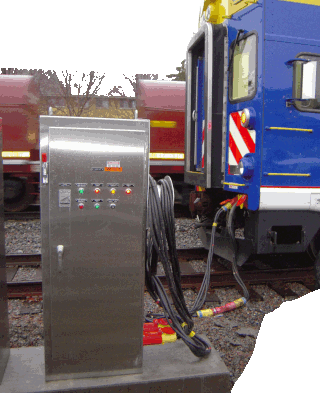
- Commuter / Regional coach: This is difficult to predict as there have been many different configurations, and there may be some adaptations for local climate as the expectation is that the cars will not move around as much as a long distance car. Please call Northwest Rail Electric for more extensive estimates based on our experience with building Yard Power Systems (shown at right) for the various commuter operators.
Related Products from Northwest Rail Electric:
For those doing a complete upgrade on a railroad passenger car, we also offer:
[ HEP Connectors ] [ Parts for Amtrak HEP ] [ HEP Generator Controls ] [ Generators for HEP ] [ HEP Wayside Power ] [ HEP Wire ] [ Railway Heating and Air Conditioning ] [ Complete Car Electrical Control Package ]
[ Railway Car Electrical Systems ]
[ Home ] [ List of Products and Services ] [ e-mail ]