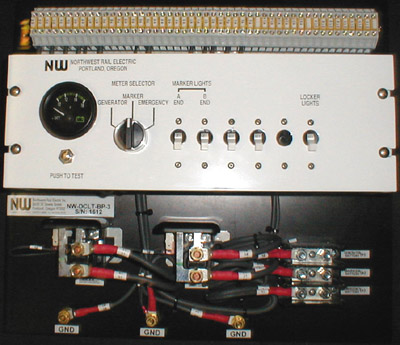
Northwest Rail Electric model # NW-DCLT-BP-3
See where our equipment is located on a typical passenger car
Northwest Rail Electric has produced a wide variety of DC systems over the years. At the simplest, these systems involve a relay to turn on the emergency lighting system when the HEP system shuts down. More complicated systems involve battery charging, circuit breaker panels, and frequently some sort of voltage indication. Even more complex systems may require DC-DC conversion to go between several different voltages. Northwest Rail Electric has produced a number of direct current control systems, including battery charging, emergency lighting and DC-DC systems that are designed to help our customers work with an assortment of voltages in a number of different applications.
Most of the time, these DC systems are part of a larger electrical locker package for a complete passenger car electrical system.
The NW-DCLT-BP-3, pictured above, is one example of a product designed to meet the needs of a number of car operators. In this particular case, all DC systems on the car are 12 volt. There are three battery systems: marker lights, generator starting and emergency lighting. These are isolated when they are being used, but when the battery charger is operating all of the batteries undergo charging. The separation of the battery systems allows the critical safety systems (marker lights and emergency lights) to operate until the battery is completely discharged without discharging the generator starting battery. This system also includes a number of dircuit breakers for the various DC loads, and a volt meter will show the battery voltage when the button on the panel is pressed.
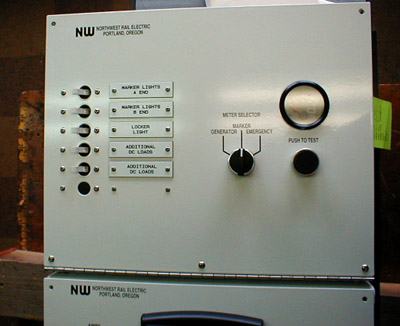
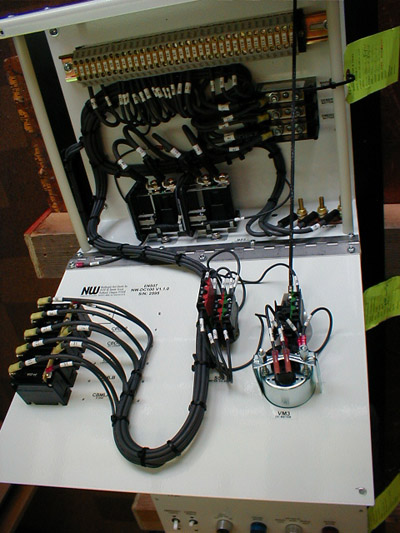
The NW-DC-100, pictured above, is very similar to the NW-DCLT-PB-3. However, it features a hinged enclosure rather than a panel configuration. The package is the same height, width, and depth as the NW25-100 and NW25-200 locker packages, allowing it to be easily added as an option to those systems.
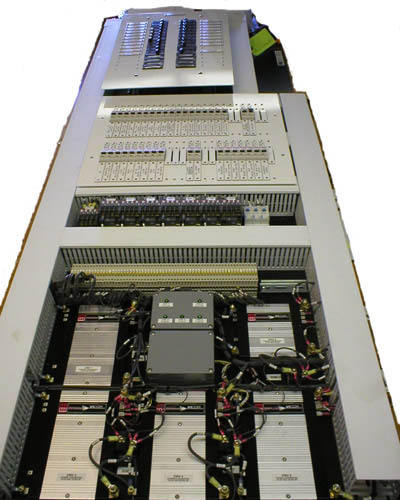
This custom DC control system includes a number of solid state DC-DC converters for taking 72 volts DC and converting it into various other voltages for use on the car for 12 volt lighting, 32 volt control systems for a previously existing 32 volt DC system, 24 volt DC for a control system that was unavailable in any other voltage, and 12 volts DC for several low voltage systems. The middle of the panel is the DC circuit breaker panel for all 72 volt, 24 volt, 32 volt and 12 volt circuits. The top of the panel includes the car's 120 and 208 volt AC circuit breaker panel. All of the circuit breakers are labeled with engraved labels.
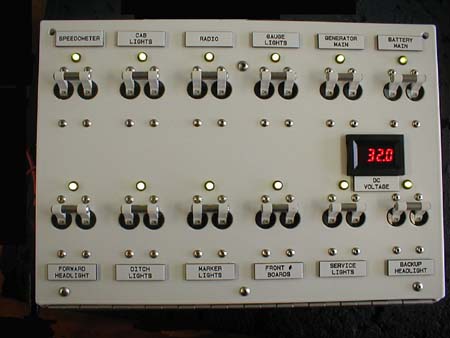
Here is a simple DC circuit breaker panel used to retrofit a steam locomotive electrical system. The panel includes two pole circuit breakers for a number of different loads, including headlights, marker lights, the turbine generator, and a 32 volt DC voltage indicator.
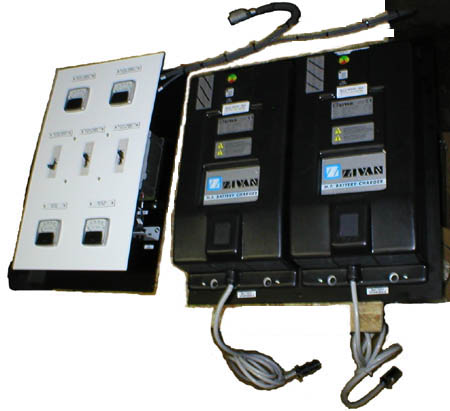
Many of today's passenger cars use nickel cadmium batteries. This package takes 480 volt three phase power from the HEP system and charges a fairly large 120 volt nickel cadmium battery bank.
 Custom Products Our Standard Products Coach Electric Locker Package List of Products and Services Northwest Rail Electric nwrail@nwrail.com